
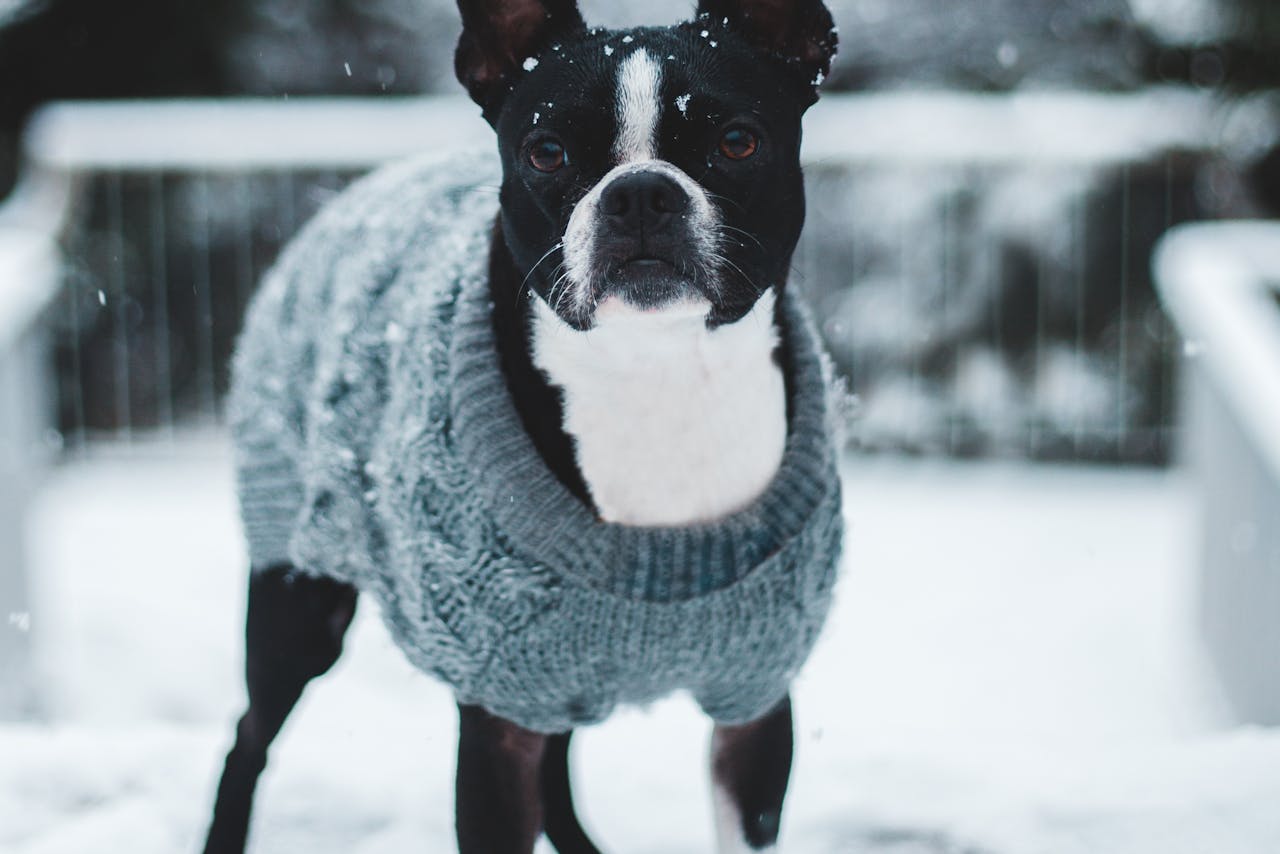
Most free dog sweater knitting patterns are sized for small dogs. The ones that do include larger sizes tend to use neck and chest measurements that don’t match real dogs – fit a large-breed dog’s chest and the neck droops; fit the neck and the sweater pulls down around the shoulders with every step. This free knitting pattern, designed by Esther Smith Bozak and online since 1995, takes a different approach: it’s built from seven measurements of your specific dog, so it fits any breed, any size, any body type.
About this pattern
Esther Bozak is a computer science professor at SUNY Oswego in upstate New York. She’s also a knitter who spent years trying to find a sweater pattern that would fit her 68-pound Australian shepherd/beagle mix – a big, active dog who needed real protection from Central New York winters.
She couldn’t find one. So she wrote her own.
The pattern was first published in 1995 and revised in 1996 after feedback from knitters across the internet – which, in 1995, was a pretty small and dedicated group. It was last updated in November 2008. The fact that it’s still online, still being used, and still being shared after 30 years says something about how well it works.
What makes it different
Most dog sweater patterns ask for two measurements: neck circumference and chest circumference. This one asks for seven. That extra detail is the whole point – the pattern uses those measurements to calculate stitch counts, shaping, sleeve placement, and body length specific to your dog rather than to a generic “medium” or “large” size category.
The result is a sweater that actually moves with the dog. No drooping neck. No pulling at the shoulders. And because the math is all proportional, it works whether you’re knitting for a four-pound Chihuahua or a 90-pound Labrador.
What you’ll need
Yarn: Wool or a wool blend with at least 50% wool content. Esther is direct about this – synthetics won’t keep a dog warm when wet, and wool will. Sport, DK, or worsted weight all work depending on your local winter. Quantity ranges from 1 oz. for very small dogs to 12+ oz. for large breeds.
Needles: Three sizes of double-pointed or circular needles. The exact sizes depend on your yarn weight and gauge. You’ll use the largest for the body, one size down for the ribbing, and three to four sizes down for the sleeve cuffs.
Skill level: Intermediate to advanced. You’ll need to know how to knit in the round, work a gauge swatch, do basic stitch-count math, and – optionally – work with steeks if you want to knit the leg openings in the round. If you’ve made a few sweaters for humans, this is very manageable. If this is your first time knitting in the round, it’s a stretch but doable with patience.
The original custom-fit dog sweater pattern
Designed by Esther Smith Bozak. Copyright 1995, 1996. Reproduced here for personal use only, with the author’s permission as stated in her copyright notice. This pattern may not be sold or used to produce items for sale. Original pattern page: Esther’s Faculty Page at SUNY Oswego.
Preface
This pattern is the result of a several years’ search for a well-fitting sweater for our 68-pound short-haired Australian shepherd/beagle mix. I ran into two major difficulties with the dog sweater patterns I was able to find: either the pattern was sized only for small dogs, or if it did come in sizes for larger dogs, the neck and chest measurements (the two usual measurements one is asked to take) didn’t match our dog’s. If I made it to fit her chest, the neck was droopy, and the dog’s movement would pull it down around her shoulders. Additionally, none of the patterns I found provided what I felt was sufficient protection for our dog against the snow and wind of a Central New York winter. So, I decided to make my own pattern and developed the following sweater to be worn by our “snow puppy” in those harsh conditions.
All comments are welcome. Please let me know about your success or problems in using this pattern, which was revised about 6 months after its initial publication because of good feedback from the net. Please include your dog’s breed and neck and chest measurements as this will help determine how robust the pattern really is. Esther can be reached at ebozak@cs.oswego.edu.
Materials
Yarn type: Wool or a wool blend (at least 50% wool). A sweater made in wool will remain warm even if it gets soaking wet. Sweaters made from synthetics will not.
Yarn weight: Sport, DK, or worsted weight – whichever suits your area’s winter weather.
Yarn amount: 1-3 oz. for very small dogs; 4-8 oz. for medium dogs; 9+ oz. for large dogs. Buy an extra skein or two – you can use any leftovers to knit a matching pair of mittens.
You’ll need three different needle sizes, each in double-pointed and/or circular style.
- Body needles: A size appropriate for your yarn weight. DPNs for small dogs, circulars for medium and large.
- Ribbing needles (neck, bottom edge, sleeve): One size smaller than the body needles.
- Sleeve cuff needles: Three to four sizes smaller than the ribbing needles.
Preparation – measurements and gauge
- Decide on your pattern stitch and ribbing stitch.
- Choose your yarn and needle size.
- Knit a gauge swatch in your pattern stitch.
- Measure your dog at seven points: (a) neck circumference; (b) chest circumference; (c) width of upper front leg at the shoulder/underarm; (d) front leg length from underarm to elbow; (e) front body depth from neck to underarm; (f) front and underside length from neck to end of rib cage; (g) back length from neck to base of tail (measured with dog sitting).
- Add ease to measurements a, b, c, and f before calculating stitch counts.
Knitting instructions
Neck: Cast on for measurement (a). Work ribbing for 1-2 inches.
Yoke: Switch to largest needles. Increase evenly to 70-75% of maximum stitch count, then continue increasing 1 stitch each side of round marker until full chest stitch count is reached. At the same time, when depth equals measurement (e), cast off for leg openings: 9.5% underside, 8% leg opening, 65% back, 8% leg opening, 9.5% underside.
Leg-openings section: Work back and underside sections separately (or use steeks) for a length equal to measurement (c). Then rejoin and cast on over the leg openings.
Chest section: Work even until length equals measurement (f). Cast off 22% of stitches for the belly.
Back section: Decrease 1 stitch each side edge every other row until 55-56% of stitches remain. Work even until 1 inch and 5 rows short of measurement (g), then decrease at side edges for 5 more rows. Place remaining stitches on holder.
Belly gusset and back ribbing: Pick up stitches along side edges, across lower back, and across belly cast-off. Work ribbing on belly stitches, then work in rounds across all stitches until side ribbing is 1 inch long. Bind off in ribbing.
Sleeves: Pick up stitches around each leg opening. Work ribbing in rounds, decreasing to cuff size in the final 3/4 inch. Bind off in ribbing.
Copyright 1995, 1996 by Esther Smith Bozak. All rights reserved. May be used by individuals for personal use only. May be distributed to and shared with others as long as it remains fully intact, including this copyright notice. It may not be sold, used to produce items for sale, used in a compilation or archive of any kind, or used in any money-making venture without the expressed written permission of the designer.
About the designer
Esther Smith Bozak is a professor in the Computer Science department at SUNY Oswego. She’s been knitting since well before the internet existed, and this pattern – first shared online in 1995 – is one of the earliest free dog sweater knitting patterns published on the web. You can visit her original pattern page at SUNY Oswego.